

When something scary happens inside every high-volume digital business, such as a checkout completion failing or a payment transaction stalling, the moment isn’t always followed by mass panic. That’s because the site isn’t down, the dashboards are technically working, and the metric doesn’t look like such a big deal at first. But it still needs to be dealt with, and at some point a team member asks the question that determines whether the business recovers in minutes or loses the afternoon: who owns this?
Rather than just being a bureaucratic reflex, the question is actually the one that determines where revenue leaks either get contained or start to spread. In many companies, the first response to a revenue issue is perfectly reasonable: start a Slack thread, review recent engineering releases, ask the product team, look for segment cuts. Marketing does whatever marketing does. Everyone is doing the right thing from their seat.
The problem is that nobody has the whole picture, and that’s why revenue-impacting issues so often take longer to resolve than anyone expects. Detection is only the first step; the hard part is turning a signal into a cause, a cause into an owner, and an owner into a safe action.
Revenue leaks rarely arrive with a name tag
Most revenue leaks aren’t clean, showing up in small shifts in specific slices of the business. Conversion is down, but only on Android. Bookings are soft, but only on a few high-traffic routes. Payment approvals look fine overall, except for one issuer range. Product availability is technically healthy, except customers in certain zip codes keep hitting dead ends. A supplier is responding, but slower than usual and only during peak demand.
In these cases, the question isn’t simply “what happened?” It’s also:
Who has the data to understand it?
Who has the authority to act?
Who can tell whether the fix is safe?
Who needs to know before anything changes?
Who owns the follow-through if the issue comes back?
Most organizations don’t struggle because their teams lack talent; they struggle because the revenue problem doesn’t match the org chart.
A single leak might touch product, engineering, payments, data, merchandising, supplier operations, and customer experience – in other words, touching teams that don’t have the full authority to take decisive action covering the entire continuum of functional groups.
The handoff is often slower than the analysis
As a result? The work becomes a chain of handoffs. Everyone looks for root cause using the tools at their disposal, not realizing that what they’re trying to find is impossible unless they have the capability to track the problem across the full length of the system. By the time the likely cause emerges, the revenue leak may have been running for hours.
That lag is expensive because high-volume consumer businesses don’t need a dramatic outage to lose meaningful revenue. A small issue in the wrong segment, at the wrong time, can compound quickly.
This is one of the central findings behind Bicycle’s view of revenue recovery: the issue isn’t only fragmented data, but rather fragmented action. Benchmark research from Bicycle shows that teams often feel confident in detection, while root-cause analysis and resolution still take much longer because the work is spread across tools, teams, and handoffs.
“Who owns this?” is really a systems question
It’s tempting to solve ownership problems with process changes. Create a RACI, update the escalation path, and add another Slack channel. Maybe document more runbooks, why not?
Those maneuvers don’t address the deeper issue: ownership changes depending on the cause.
If checkout conversion drops, the owner could be product, engineering, payments, fraud, performance, experimentation, or a third-party provider. If availability-driven conversion falls, the owner could be merchandising, store ops, inventory systems, search ranking, replenishment, or fulfillment. If bookings drop in travel, the owner could be supplier operations, cache freshness, pricing, payments, mobile performance, or partner integrations.
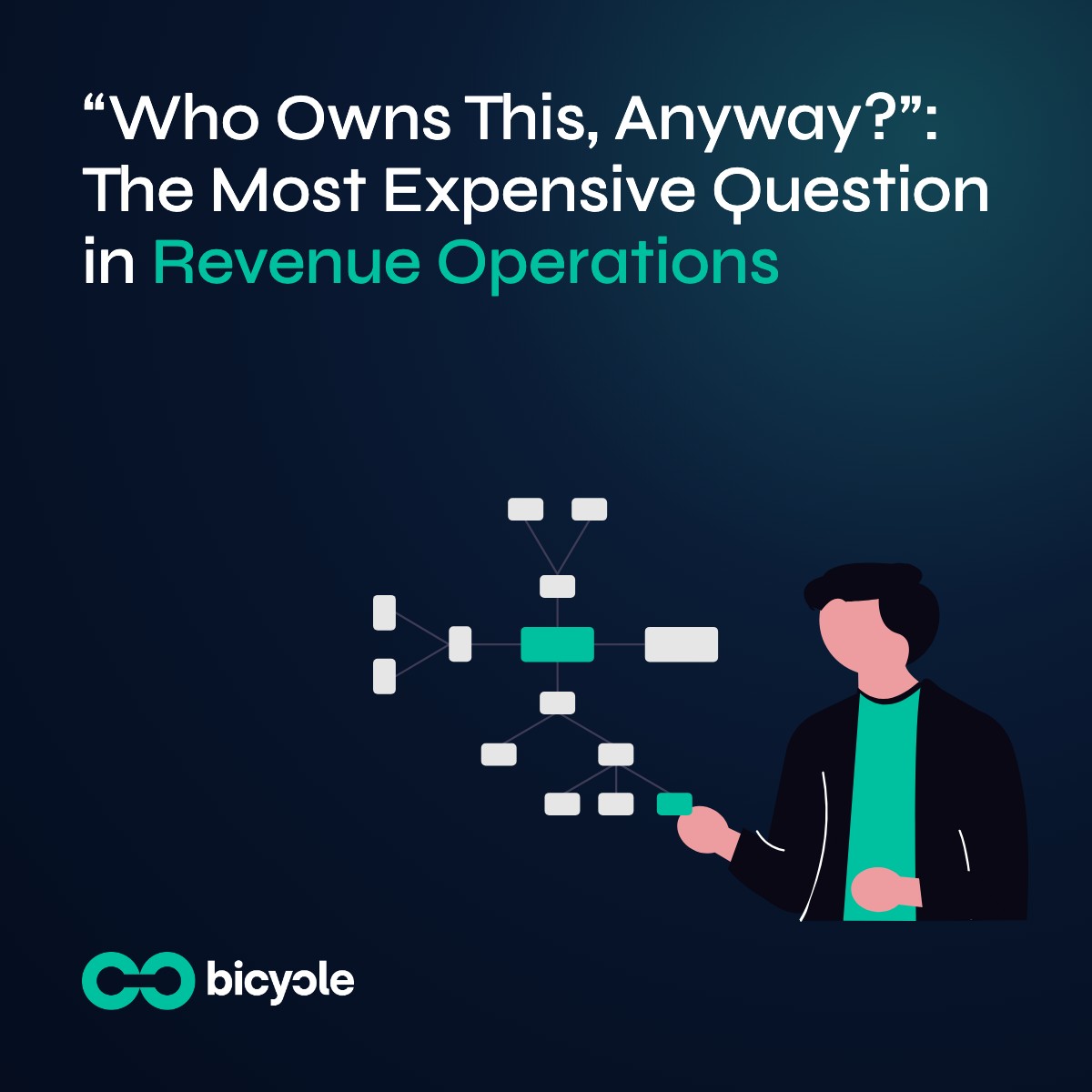
You can’t assign ownership properly until you understand the shape of the problem. That’s why the next generation of revenue operations needs a shared operating map. Bicycle calls this an ontology: a business-aware model that connects KPIs, events, dimensions, systems, causes, owners, and actions. It gives the analytics and agent engine the context to understand how the business works, not just what the latest metric says.
In practical terms, that means Bicycle doesn’t only see that revenue moved. It understands the relationships around that movement:
Which KPI changed?
Which event path is affected?
Which dimensions make the issue specific?
Which technical or operational signals changed at the same time?
Which causes are most likely?
Which team owns the next step?
Which actions are available, safe, reversible, and measurable?
That context is what turns “who owns this?” from a debate into a plan for action.
The real job is connecting business signals to operational reality
Bicycle helps teams shift from business signal to action, similar to how application performance monitoring once connected technical issues to user experience. The idea is to move beyond charts about isolated systems and connect a signal to the likely cause and the next step.
When teams investigate through their own tools, they naturally start from their own domain. Bicycle’s approach is to start from the revenue signal and work outward across the connected business context. That changes the conversation. Instead of asking, “Does anyone know why this is happening?” the system can say:
“Conversion is down for mobile users in this region. The affected sessions are concentrated in checkout. Payment authorization latency rose at the same time for this gateway and issuer group. Recommended next step: reroute this segment and monitor approval lift.”
Or:
“Search-to-purchase conversion is down for these SKUs in these locations. Inventory is available in the system of record, but store-level availability is out of sync. Recommended next step: refresh the affected inventory slice and suppress unavailable results until sync recovers.”
Or:
“Bookings are down on high-traffic routes while re-prices are up. Supplier latency and fare-cache staleness increased in the same window. Recommended next step: refresh affected cache keys and temporarily de-prioritize the degraded supplier.”
In each case, ownership becomes clearer because the cause path is clearer. When the system can connect the signal, cause, owner, and recommended action, the conversation becomes much calmer. The right team gets the right context, the action is scoped, the impact is measurable, and the rollback path is clear.
The best ownership model is dynamic
Traditional ownership models assume that each metric has a fixed owner. In reality, the right owner depends on why the metric moved.
This is where agentic analytics becomes useful. The promise isn’t that AI magically fixes every issue. The promise is that an AI analyst with the right business context can reduce the amount of human coordination required to get to the next responsible step.
It can detect that something changed, explain the likely driver, route the issue to the right owner, recommend a safe intervention, and trigger or prepare the action where guardrails allow. It can monitor whether the action worked. It can even preserve the learning for next time.
A good revenue system should get smarter every time. It should remember the pattern, the owner, the action, and the outcome.
The future of revenue operations is coordinated action
In Bicycle’s architecture, this is the move from static reporting toward an expert agent: a system that understands KPIs, events, dimensions, patterns, causes, and actions, then helps teams move from what happened to why it happened to what to do next.
For revenue teams, that shift changes the practical meaning of ownership. Ownership is no longer just a box in an org chart; it’s an outcome of understanding the issue well enough to act.
The companies that improve here will recover faster because they won’t start every incident with a broad investigation. They’ll start with a connected view of the business, a likely cause, a recommended owner, and a next step that can be tested safely.
The question “Who owns this?” will always matter. But it shouldn’t be the question that slows everything down. In a modern revenue operation, the system should help answer it before the leak has time to become a loss.