

There's a specific kind of retail pain that never shows up cleanly in a quarterly review.
It's 4:17 PM. A "boring" item—milk, tomatoes, diapers—quietly goes unavailable in one zone. Customers searching for it start bouncing. Revenue dips. Someone in Category Management blames pricing. Replenishment thinks it's a supply issue. Store Ops says the store was online. Meanwhile, customers do what customers do: they don't file tickets—they just leave.
Most teams don't fail because they're lazy. They fail because the work is distributed, time-sensitive, and has multiple possible causes… and the tooling is usually built for hindsight.
The fulfillment and ops leaders who handle this well share a common trait: they close the loop from signal → explanation → action fast enough that the shelf doesn't stay empty and the backroom doesn't fill up.
The Real Problem: Inventory Issues Are Revenue Leaks, But Most Tools Treat Them Like Reports
Two uncomfortable truths:
- Stockouts hurt revenue fast—you feel it immediately in conversion and customer trust.
- Overstock quietly bleeds margin through markdowns, spoilage, and working capital tied up in the wrong place.
And yet most organizations manage both with weekly cadence, partial data, and a Slack thread.
The best retail ops teams don't obsess over "more metrics." They obsess over fewer decisions, made faster, with good enough certainty. The work isn't staring at dashboards—it's the scramble when a product disappears and teams can't coordinate quickly.
One online retailer we worked with was running exactly this scramble daily. Their top 1,000 SKUs sat at roughly 80% availability. Root cause investigations were manual, often taking a full day. By the time they figured out why something went out of stock, the damage was done.
The Mental Model: Stockouts and Overstock Are the Same Failure, Opposite Ends
Think of every product-location combination as having a living "balance":
- Demand signal: searches, views, add-to-cart, orders
- Supply reality: what's on hand, what's in transit, supplier confirmations
- Customer promise: delivery window, substitution rules, what the site says is available
- Commercial pressure: pricing, promotions, competitor moves
When those drift out of sync, you get one of two outcomes. Stockout: demand is real, supply isn't there. Overstock: supply is there, demand isn't, and you keep feeding the beast.
Most organizations try to fix this with better forecasting. That helps, but it doesn't touch the real operational question: When something moves, can we explain it fast enough to act before the revenue leak compounds?
The Leading Indicator Most Inventory Teams Underuse: Search Behavior
In grocery and quick commerce, sales are a lagging indicator. Customers tell you what they want before they buy—they search, they click, they add to cart. Then (if you don't mess it up) they order.
The best ops teams treat search conversion (add-to-cart divided by searches) as their canary. When 70% of transactions start with search, drops in search conversion are often the first sign something's wrong—before it shows up in the revenue line.
If "milk in [neighborhood]" has normal search volume but conversion drops, it's often availability, catalog issues, pricing, or relevance. If search volume spikes unexpectedly, your replenishment plan is about to be wrong.
This is where the investigation usually stalls. You see the dip. You don't get a ranked explanation of why, and you definitely don't have a next step ready.
Why This Is Hard in Practice: Scale Breaks the Manual Approach
Retail leaders love to say "we track availability." What they often mean is a daily in-stock flag, an overall out-of-stock percentage, maybe a top-20 list of problem items.
But the operational reality for a major grocer or omnichannel retailer is closer to tracking patterns across hundreds of products × hundreds of locations. At that scale:
- Baselines vary by store and by zone
- "Normal" for milk is nothing like "normal" for specialty items
- Alert thresholds can't be one-size-fits-all
This is where teams usually add more dashboards… and then adoption drops because people can't operationalize them. The fulfillment director doesn't need another place to look at numbers. They need to know what changed, why, and what to do about it—now.
What the Best Ops Teams Actually Do: Four Things, Consistently
The teams that prevent inventory incidents (rather than just document them) do four things reliably:
- Detect the right changes early, at the right granularity (product × location, not national averages)
- Explain likely causes with evidence—running a consistent checklist, not a free-form investigation
- Route the incident to the person who can actually fix it (not "inventory team notified")
- Act safely—with changes that are reversible and logged
Let's make that concrete.
A Running Example: "Milk" Dips in One Neighborhood
Imagine this detection: search conversion for milk in one zone drops below its baseline. Search volume is stable (so it's not "nobody wants milk today"). The system flags it as a real anomaly.
Once detected, the diagnosis shouldn't be an open-ended investigation. It should be a consistent checklist, run quickly, with evidence. The "why" isn't philosophical—it's operational. You actually have to test:
- Is the item out of stock?
- Was a purchase order not placed?
- Did the supplier deliver late or short-ship?
- Was there an unexpected demand spike?
- Did pricing change (yours or a competitor's)?
- Is this a catalog or search relevance issue?
- Is a similar product cannibalizing demand?
- Is there a local event or seasonal pattern?
- Is the store actually able to fulfill?
That checklist is what separates "we track inventory" from "we stop revenue leaks before they compound."
Six Questions That Reveal Whether You're Set Up to Prevent Problems—Or Just Document Them
1. Can you measure availability in minutes, not days? A product can be unavailable for 6 hours during peak demand and still show "available today" in a daily report. If your dashboard looks fine but customer experience is screaming, this is often why.
2. Do you have at least one leading indicator that shows intent before sales? Search and add-to-cart behavior are brutally honest. Sales come later.
3. Can you monitor at the granularity where the business actually breaks? Product × store, or product × delivery zone—not national averages.
4. When an alert fires, does it come with "what changed" and "how big is the impact"? A 12% drop on a high-volume item is not the same as a 12% drop on a niche product.
5. Can you distinguish "actually out of stock" from "the website thinks we're out of stock"? Sometimes the inventory is there and customers still can't buy it—because the catalog is inactive, or an availability feed is stale. These are the most infuriating incidents because everyone swears their system is correct.
6. Does the diagnosis route to the person who can actually fix it? "Inventory team notified" is not an action. It's an invitation to delay.
Where AI Agents Fit: Running the Loop Humans Can't Sustain
Here's the honest reality: running this kind of loop manually—monitoring thousands of product-location combinations, checking a consistent cause list, routing to the right owner, proposing safe actions—is operationally exhausting. It's why most teams default to weekly reviews and reactive firefighting.
This is where AI agents start to make practical sense. Not as a replacement for retail expertise, but as the layer that runs the detect-explain-route-act loop continuously, at a scale humans can't sustain.
The pattern: the agent monitors the signals, runs the diagnostic checklist when something moves, surfaces what changed with evidence, and proposes next steps that humans can review and approve. The ops team stays in control—they set the thresholds, define what "normal" looks like, approve the actions. The agent handles the relentless monitoring and consistent diagnosis.
The online retailer I mentioned earlier moved to this model. Availability on their top SKUs improved from roughly 80% to 95%. Root cause investigation went from daily-and-manual to real-time. The fulfillment team transitioned from reactive crisis management to strategic, proactive operations.
This is what we're building at Bicycle: agents that handle retail operations intelligence end-to-end, sitting on top of existing systems. The goal isn't another dashboard—it's turning signals into explained, routed, safe-to-execute actions, fast enough to stop revenue leaks before they compound.
The Bottom Line
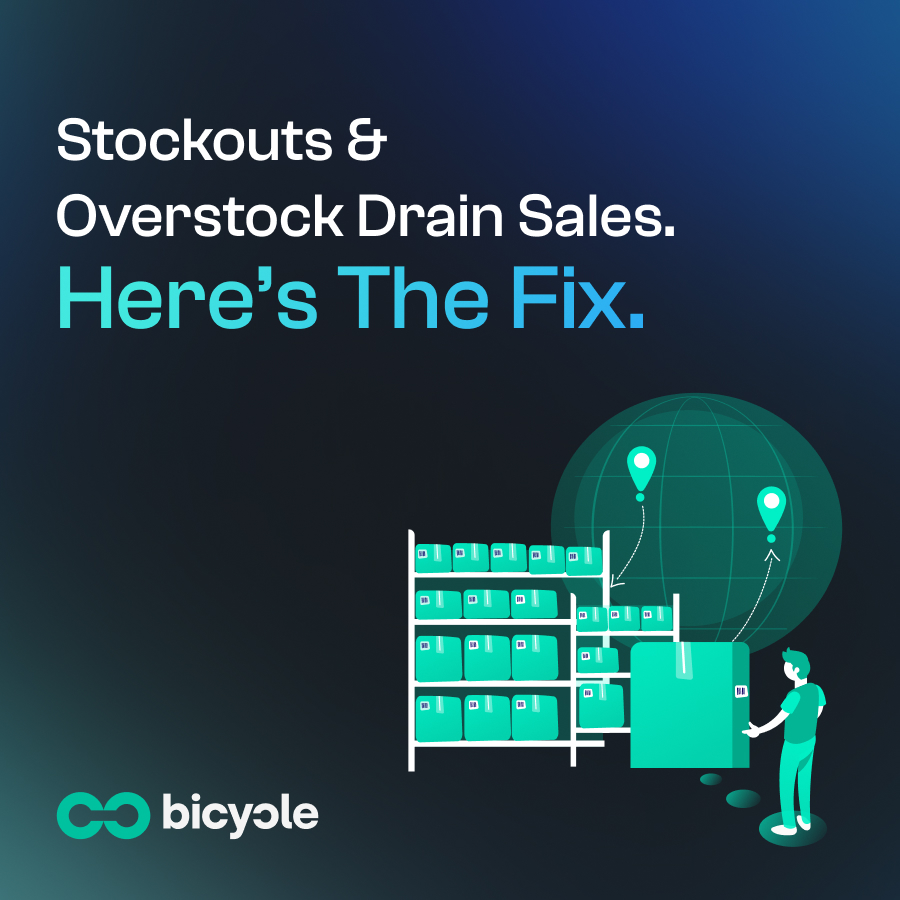
Stockouts and overstocking aren't just inventory problems. They're coordination problems across demand signals, operational reality, and commercial decisions—usually under time pressure.
The Ops teams that handle this well detect early at product-location granularity, run a consistent diagnostic checklist, route to the right owner, and propose reversible actions. That's how you stop a localized availability wobble from becoming a revenue leak—and how you keep excess inventory from quietly draining margin.
One takeaway: treat search and add-to-cart behavior as early-warning signals, treat diagnosis as a repeatable checklist (not an investigation), and treat actions as reviewable, auditable steps—not heroic Slack threads.
Bicycle AI helps retail and fulfillment teams run this kind of operations intelligence loop with AI agents that detect, explain, route, and act—with humans in control. If this resonates, we'd like to hear from you.