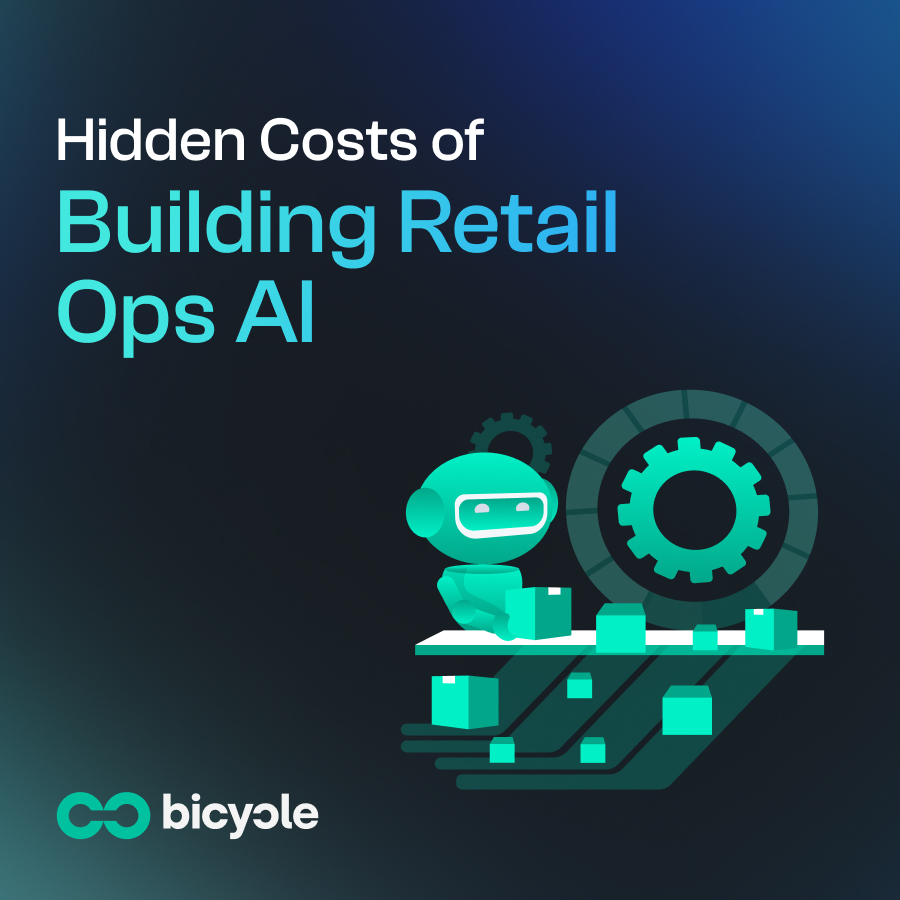


Most retail teams don't start with a "build vs buy" debate.
They start with something way more practical:
"Can we get an AI assistant to tell us why pickup cancellations spiked last weekend… and what to do before it happens again?"
So someone prototypes. A couple dashboards get wired into a chat interface. It demos well.
And then the project hits the part nobody put in the slide deck: to make an AI agent for retail ops dependable, you're not building an assistant. You're building an operating system for decisions.
Gartner recently predicted that over 40% of agentic AI projects will be canceled by the end of 2027, citing escalating costs, unclear business value, or inadequate risk controls. That stat isn't about the models being bad. It's about teams underestimating the "everything around the model."
This post is about "everything."
Not to scare anyone off AI agents in retail ops—quite the opposite. It's to make the work visible so leaders can choose deliberately: what's truly differentiating for you to build, and what's table-stakes plumbing you really don't want to own.
The Demo Is Easy. Tuesday Morning Is Hard.
Retail ops is messy by nature: availability is local (product × store × zone), demand shifts fast, fulfillment is constrained by labor and cutoffs, returns inject noise back into inventory accuracy, and customers don't care why your systems disagreed—they just see "not available."
If an ops agent is going to be trusted, it needs to do four things every time:
- Notice a meaningful issue (not noise)
- Explain likely causes with evidence
- Route it to the person who can fix it
- Propose (or take) safe, reversible action
That's the promise. Here's the hidden work.
What Teams Think They're Building Vs. What They're Actually Building
What it sounds like: "An AI agent that can query our data and answer questions."
What it actually is (if it's going to work in production): "A system that converts raw retail signals into repeatable decisions."
That system has a bunch of parts. None are glamorous. All are required.
The scope creep happens one small "oh, also…" at a time. Here's what the best teams have learned to anticipate:
1. A business map of retail ops (because the model can't guess your definitions)
If you want an agent to answer "why did omnichannel conversion drop," it needs to understand what those words mean in your business:
- What is "available"? (On-hand? Sellable? Pickable? Within the promise window?)
- What counts as a cancellation? (Customer cancel vs. operational cancel vs. payment failure?)
- What's a "late pickup"? Does it hit revenue or just labor?
This is the unglamorous foundation: a semantic layer that ties metrics to real events and entities. Without it, the agent will do what every new analyst does—confidently mix definitions from three dashboards and call it insight.
2. A way to ingest all the right signals (not just the clean warehouse tables)
Retail ops doesn't live in one system. The agent needs to read across: the digital journey (search → product views → add-to-cart → checkout), order events (statuses, splits, substitutions, cancellations), store operations (pick timestamps, exceptions, staging, handoff), inventory and catalog (availability feeds, item status changes), supply chain (purchase orders, receiving, fill rates, lead time drift), and external factors (weather, local events, competitor pricing).
McKinsey has been direct about why retail AI pilots don't scale: data quality constraints, insufficient expertise, and implementation costs are common blockers. That's not "AI is hard." That's "retail data is fragmented, and ops is cross-functional."
3. Continuous monitoring that doesn't drown everyone in noise
Retail leaders don't need 200 alerts. They need 5 alerts they'll actually trust.
That means baselines that vary by product, store, day-of-week, and hour-of-day. Volume-aware thresholds (a 10% move on a low-volume item is not the same as on a high-velocity one). Impact estimation (is this a rounding error or a real revenue leak?).
Getting this right is more engineering and product design than data science. It's why many internal attempts stall: the first month is a flood of false positives, then everyone turns alerts off, and the agent becomes a fancy search bar.
4. Root cause analysis that behaves like your best operator
When something breaks in omnichannel, the "why" is rarely one thing.
Example: pickup cancellations spike in two districts. Possible causes include inventory record mismatch (system says yes, shelf says no), store pick capacity constraint, catalog item marked inactive in those stores, promise window got tighter due to a configuration change, payment authorization failures for a specific method, or a promo that increased demand on already-thin supply.
A real ops agent needs a repeatable investigation flow: check real-time availability vs. daily flags, correlate with pick exceptions, validate catalog status changes, compare demand signals vs. supply signals, isolate the blast radius to specific products, stores, or payment methods.
This is where generic AI starts to struggle—it can talk about causes, but it won't consistently run your business's checks unless you encode the logic and connect the tools.
5. The tool layer: the agent has to actually do things
Retail ops isn't solved by explanations. It's solved by actions.
To be useful, the agent needs to query data across warehouses and streaming events, check order management and inventory feeds, open a ticket with the right context, message the right owner, and propose a fix (sometimes execute it).
This orchestration layer is where projects become real software. It's also where risk lives.
6. Safe actions, approvals, and undo
If the agent can change something—availability display, substitution rules, routing logic, promo eligibility—you need guardrails: which actions are allowed automatically vs. require approval, who approves (by role), what's the rollback plan, and what gets logged for audit.
McKinsey's State of AI research has emphasized that high performers are more likely to have defined processes for when human validation is required. Retail teams are allergic to "black box automation," especially when it touches revenue and customer promises. If you don't design for reversibility and auditability, adoption stalls—quietly.
7. Routing and ownership
Even perfect insight is useless if it goes to the wrong person.
An omnichannel incident often has multiple owners: category and merchandising cares about demand shaping (pricing, promos, substitution), store ops cares about execution (picking, staffing, staging), supply chain cares about replenishment (purchase orders, fill rates, lead times), and product/engineering cares about systemic issues (latency, indexing, configuration).
So the agent has to identify the likely cause and route it to the owner who can act, with just enough context to move. This is the difference between "we notified the ops channel" and "the issue got fixed."
8. Policy ingestion: your rules live in documents and tribal knowledge
Retail ops isn't only data. It's policy: substitution rules, return eligibility, store fulfillment constraints, promo exceptions, vendor lead-time agreements, what counts as a critical incident.
Most of that lives in documents, screenshots, or someone's head. If the agent can't use that context, you'll get answers that sound smart and fail in practice—because they violate a policy your team actually follows.
9. Evaluation and drift
The minute you ship an agent into ops, you inherit a new operational burden: did it catch incidents we care about? Did it miss any? Did it recommend the right action? Did the action help or hurt downstream metrics? How did this change after the last system rollout or vendor change?
This is where many internal builds quietly die—not in a blaze of failure, but in slow entropy.
The Uncomfortable Part: Building This Well Competes With Your Core Roadmap
Every one of the components above is reasonable on its own. Together, they add up to a platform: data integration, semantic modeling, monitoring, root cause logic, orchestration, governance, routing, and ongoing evaluation.
If you're a retailer, your core differentiation is usually not "we built the world's best agent framework." It's merchandising, supply chain, customer experience, brand, store execution.
So the strategic question becomes: do you want to run two businesses—retail and a decision-automation software platform?
When Building Does Make Sense
Some retailers genuinely should build major parts internally. Usually because they have massive scale and unique workflows, a deep engineering bench already dedicated to internal platforms, a desire to make AI a primary interface across many employee workflows, and the patience to iterate through governance and adoption.
Walmart is a good example—they're investing heavily in AI agents across shoppers and internal users, framing them as core interfaces over time.
If you're in that category, building can be a competitive weapon. But most retailers are not Walmart.
Why Buying Is Often the Faster Route to Real Ops Impact
In enterprise AI broadly, there's growing evidence that organizations are increasingly purchasing AI capabilities rather than building them internally. Menlo Ventures' 2025 enterprise AI report describes a shift toward buying for speed-to-production and clearer value realization.
In retail ops terms, buying tends to win when you need impact this quarter (not next year), you can't afford alert fatigue and governance mistakes, you want proven patterns for inventory, pricing, labor, and fulfillment exceptions, and you want safe action workflows without rebuilding your entire stack.
The nuance: buying doesn't mean "rip out your dashboards." It often means "add an operational layer that turns signals into decisions."
A Better Framing Than "Build Vs Buy"
Instead of asking "Should we build an agent?", the better question is: What do we want to own forever?
- Own your first-party data and core business logic.
- Own the decisions that differentiate your customer experience.
- Don't own the plumbing that every retailer needs and nobody gets promoted for rebuilding.
That last line sounds cynical, but it's how most data and analytics leaders actually think—especially when they've lived through one "we'll just build it" cycle already.
The Bottom Line
AI agents are transforming omnichannel retail ops. But the transformation isn't "we added a chatbot."
It's the business operationalized how it detects issues, explains them consistently, routes them to the right owner, and takes safe action—fast enough to stop revenue leaks before they compound.
If you can do that with an internal build and you're staffed for it, great. If not, don't confuse a prototype with a platform—and don't accidentally sign up to build a second company inside your retailer.
This is the problem Bicycle is built to solve: AI agents that handle retail operations intelligence end-to-end—detecting issues, explaining root causes, routing to the right owner, and proposing safe actions—so your team can focus on retail, not on building agent infrastructure. If this resonates, we'd like to hear from you.