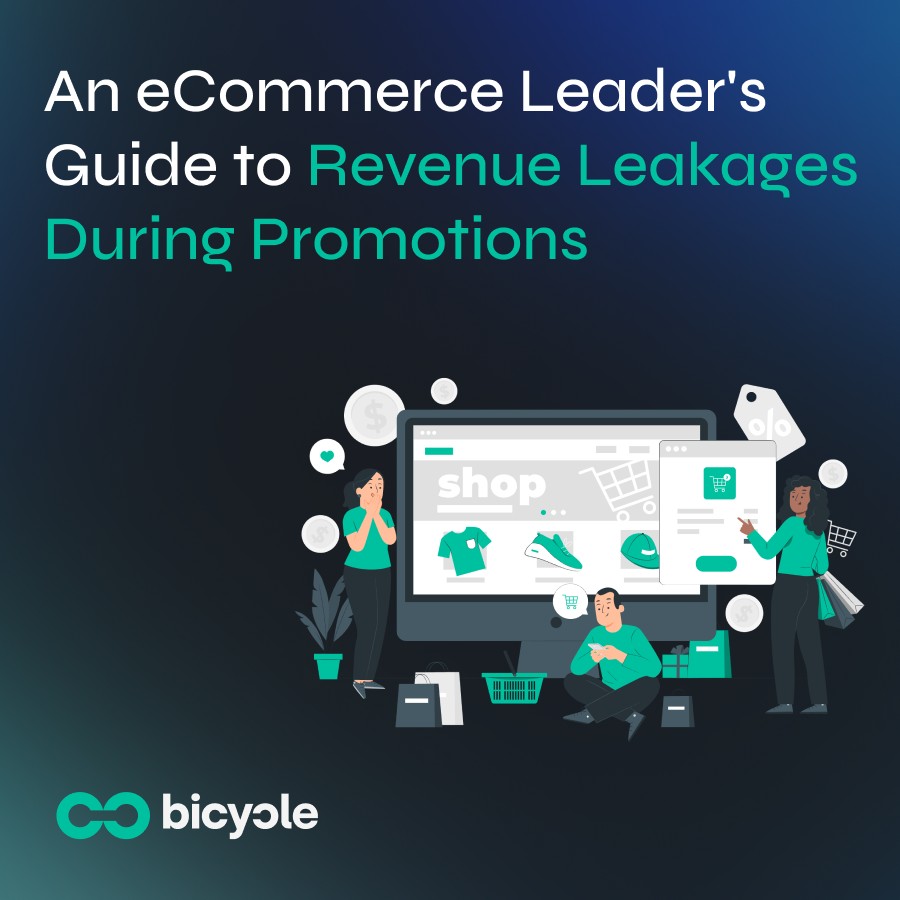


An eCommerce Leader’s Guide to Revenue Leakages During Promotions
Promotions are supposed to create urgency, lift conversion, and move inventory. But for many eCommerce teams, they also create the perfect conditions for revenue leakage.
A campaign goes live. Traffic spikes. Discounts stack in unexpected ways. Paid media keeps pushing shoppers toward low-stock products. Checkout gets slower under load. Wallet approvals dip for a narrow segment. Store pickup promises become unreliable. By the time teams notice, the promotion may still look “successful” at the top line while margin, conversion, and customer trust are invisibly leaking underneath.
That’s what makes promotional leakage so dangerous: it rarely looks like a dramatic outage. It looks like small percentage shifts inside high-volume moments. But small shifts compound fast during major campaigns.
Bicycle.ai’s research with product and analytics leaders found that many teams are confident in their ability to detect revenue-impacting issues, but the recovery loop is still too slow. Issues are often discovered by customers, take an hour or longer to fix, and frequently recur within weeks. The core problem is not lack of dashboards, but rather fragmented data, unclear ownership, and too much delay between signal, root cause, and action.
Why promotions create hidden revenue leaks
A normal trading day may tolerate small gaps in inventory accuracy, pricing rules, site performance, or payment routing. During a promotion, those same gaps become expensive.
The most common promotional leaks tend to happen in five places.
1. Promo stacking that burns margin
The most obvious leak is also one of the easiest to miss: discounts combine in ways the business did not intend.
A site-wide code overlaps with a category discount. A loyalty offer stacks with a brand-funded coupon. A bundle incentive applies to items that were already deeply marked down. The result may be strong order volume, but weak contribution margin.
This is especially painful because the campaign may appear healthy in standard dashboards. Revenue is up. Units are moving. Conversion is strong. But the lift is being subsidized by unnecessary discount depth.
What to watch:
Track promotion performance not just by revenue and conversion, but by unit margin, discount depth, average order value, and stacking combinations. Segment by SKU, category, channel, geography, customer cohort, and device.
What to do:
Build real-time checks for promo conflicts. When a discount combination starts eroding margin, the system should flag the affected SKUs, quantify the impact, and recommend a smaller corrective action — such as removing stacking on overlapping items, swapping to a bundle credit, or narrowing eligibility to the segment where the promo actually drives incremental demand.
Bicycle.ai particularly sees the pain promo and pricing leakage problems when we talk to retail companies for the first time, including margin erosion from promo stacking, misconfigured discounts, and price rules drifting by channel. These are extraordinarily common issues.
2. Paid traffic sent to products that cannot convert
Promotions often fail because the marketing engine is not aligned with operational reality.
A paid campaign drives traffic to a hero product where the most popular sizes are nearly out of stock. An email blast sends shoppers to a product that is available in one region but not another. A social campaign keeps promoting a bundle even though one component has limited fulfillment capacity.
The leak here isn’t just out-of-stock loss but rather wasted media, lower return on ad spend, abandoned sessions, and frustrated shoppers.
What to watch:
Monitor campaign traffic against live availability, variant depth, regional fulfillment capacity, and delivery promise accuracy. Look beyond product-level inventory. Promotional campaigns often leak at the size, color, store, distribution center, or zip-code level.
What to do:
Shift spend and onsite placement toward products that can actually ship. Pause ads for depleted variants. Geo-limit promotions when regional inventory is constrained. Re-rank search and category pages toward in-stock alternatives.When campaigns push traffic to items that can’t ship, corrective actions include pausing spend to out-of-stock variants and routing shoppers to in-stock sizes.
3. Checkout and payment leaks at peak intent
Payment leakage is especially costly because it happens at the finish line. The shopper has already searched, compared, added to cart, and decided to buy.
During promotions, checkout systems are under more pressure. Payment gateways see higher volume. Fraud and authentication rules may behave differently. Buy Now, Pay Later, wallets, and card routes may perform unevenly by device, issuer, geography, or order value.
The danger is that overall approval rate can look fine while a valuable slice is failing.
For example, wallet payments may time out on older Android devices. A specific issuer group may decline more high-ticket promotional orders. 3-D Secure may over-challenge low-risk shoppers in one region. A gateway route may degrade during a campaign window.
What to watch:
Track payment completion by method, device, issuer, country, card type, gateway route, authentication flow, and order value. Don’t rely only on blended approval rate.
What to do:
Detect the failing slice early and apply targeted mitigations: route affected traffic to a healthier provider, prompt an alternate payment method, adjust authentication rules for low-risk transactions, or simplify checkout prompts. Bicycle.ai typically sees payments as one of the most dangerous revenue leaks because a failed payment means losing a customer who was already ready to buy.
4. Site performance issues that only appear under campaign load
A promotional campaign can expose performance issues that normal traffic does not reveal.
A new personalization widget slows product pages. A tag manager update creates checkout JavaScript errors. Image weight increases after a campaign landing page refresh. A third-party script behaves poorly on mobile. The site is not “down,” but pages become just slow enough to suppress conversion.
These are hard leaks because they often appear as business problems first: lower add-to-cart, weaker checkout completion, lower conversion on mobile, or underperformance in a specific campaign channel.
What to watch:
Track conversion alongside page speed, errors, latency, third-party scripts, feature flags, and recent releases. Segment by campaign, landing page, device, browser, geography, and funnel step.
What to do:
Tie performance changes directly to revenue impact. When conversion dips after a campaign launch, teams need to know whether the issue is creative, offer quality, traffic mix, inventory, or performance. The right fix may be small: defer a script, roll back a feature flag, compress images, add a CDN rule, or simplify the landing page.
Bicycle.ai sees checkout and site performance regression as a revenue leak that can be correlated with latency spikes, third-party script issues, and recent releases, with recommended actions such as rollback, feature-flag changes, and routing mitigations.
5. Fulfillment promises that promotions make impossible to keep
Promotions don’t end at checkout. They also stress fulfillment.
A Buy Online, Pick Up In Store campaign may increase orders faster than store teams can pick and stage them. A delivery promotion may overpromise slots in certain zip codes. A discounted bulky item may convert well but overwhelm carrier capacity. A regional promotion may create demand in stores that don’t have the right inventory depth.
The leak appears later as cancellations, substitutions, missed pickup windows, late deliveries, customer service tickets, and refunds. But the revenue damage starts during the promotion, when the site keeps making promises the operation cannot support.
What to watch:
Monitor pickup capacity, delivery slots, staging congestion, carrier availability, cancellation rates, substitutions, and promise accuracy by store, region, SKU, and daypart.
What to do:
Adjust promises in real time. Cap pickup slots. Rebalance orders to nearby stores. Narrow delivery windows. Redirect demand toward locations with capacity. Promote substitutes where appropriate. Bicycle’s webinar emphasizes that promise breaks can quickly turn revenue leaks into brand damage, especially when teams wait for weekly reviews instead of acting in the moment.
The promotion leakage checklist
Before your next major promotion, eCommerce leaders should pressure-test the full revenue loop:
Pricing and margin
Are discounts stacking as intended? Are promo rules consistent across site, app, store, marketplace, email, and paid media? Can you see margin impact by SKU and cohort during the campaign, not after?
Inventory and availability
Are campaigns aligned to live inventory by variant, store, distribution center, and region? Are you still spending against products that cannot fulfill demand?
Site and app experience
Did any recent release, tag, widget, creative refresh, or experiment affect page speed or checkout performance? Can you connect latency to conversion impact?
Checkout and payments
Can you see payment success by issuer, method, device, gateway, geography, and authentication flow? Do you have safe fallback routes or alternate prompts ready?
Fulfillment promises
Are delivery and pickup promises realistic under promotional demand? Can store, warehouse, and carrier capacity keep up with what the website is promising?
Ownership
When something moves, who owns the first response? Pricing? Merchandising? Growth? Product? Engineering? Payments? Operations? Data? If five teams need to investigate before anyone acts, the leak will keep running.
From dashboards to action
Most eCommerce teams already have dashboards. The problem is that dashboards usually stop at “something changed.”
During a promotion, that is not enough.
Teams need to know:
- What changed?
- Where is it happening?
- Why is it likely happening?
- How much revenue or margin is at risk?
- What is the safest next action?
- Who owns that action?
- Can it be rolled back?
This is where agentic analytics changes the operating model. Instead of asking teams to manually stitch together data from ecommerce platforms, warehouses, payment systems, inventory feeds, performance tools, and ticketing systems, AI can act as connective tissue across the revenue stack.
Bicycle.ai is built around this shift: connecting transactions, payments, catalog and inventory, site and app performance, and operational tools so teams can move from signal to cause to action.
The takeaway
Promotions will always carry risk, but revenue leakage shouldn’t be treated as the cost of doing business.
The best eCommerce teams are moving beyond post-campaign analysis. They’re building real-time recovery loops and a team of agents that detect leakage, explain root cause, recommend action, and help teams respond before a small issue becomes a margin event.
Because during promotions, speed is not just an operational advantage: it’s the new margin protector.